There’s this nerdy urbanist idea that a Land Value Tax (LVT) is a better way to levy property taxes. In our current system, the land component is taxed at a very small value, and the building value is taxed quite heavily. This means that if you build no building, or have a dilapidated old building (or a parking lot), you pay very little in taxes. Walmart, Lowe’s, and Meijer have all made a business strategy out of this, and it costs cities real money.
A true LVT taxes land value, not area. Estimating parcel-by-parcel land values for Grand Rapids is beyond the scope of this article, so instead I’ll use a flat per-acre proxy. It isn’t how an LVT would actually work, but it’s useful for estimating the overall order of magnitude.
Economists often describe land as the ideal tax base because its supply is fixed. Taxing labor discourages work. Taxing buildings discourages construction. Taxing land doesn’t reduce the amount of land that exists, so it creates much smaller economic distortions.
Also, buildings depreciate while land usually appreciates because of surrounding community investment. Cities create land value, and owners of that land capture it. A LVT partially returns that value to the community. One important note: a LVT isn’t about collecting more taxes. It’s about collecting roughly the same amount of revenue from a different tax base.
Land Value Tax vs. Traditional US System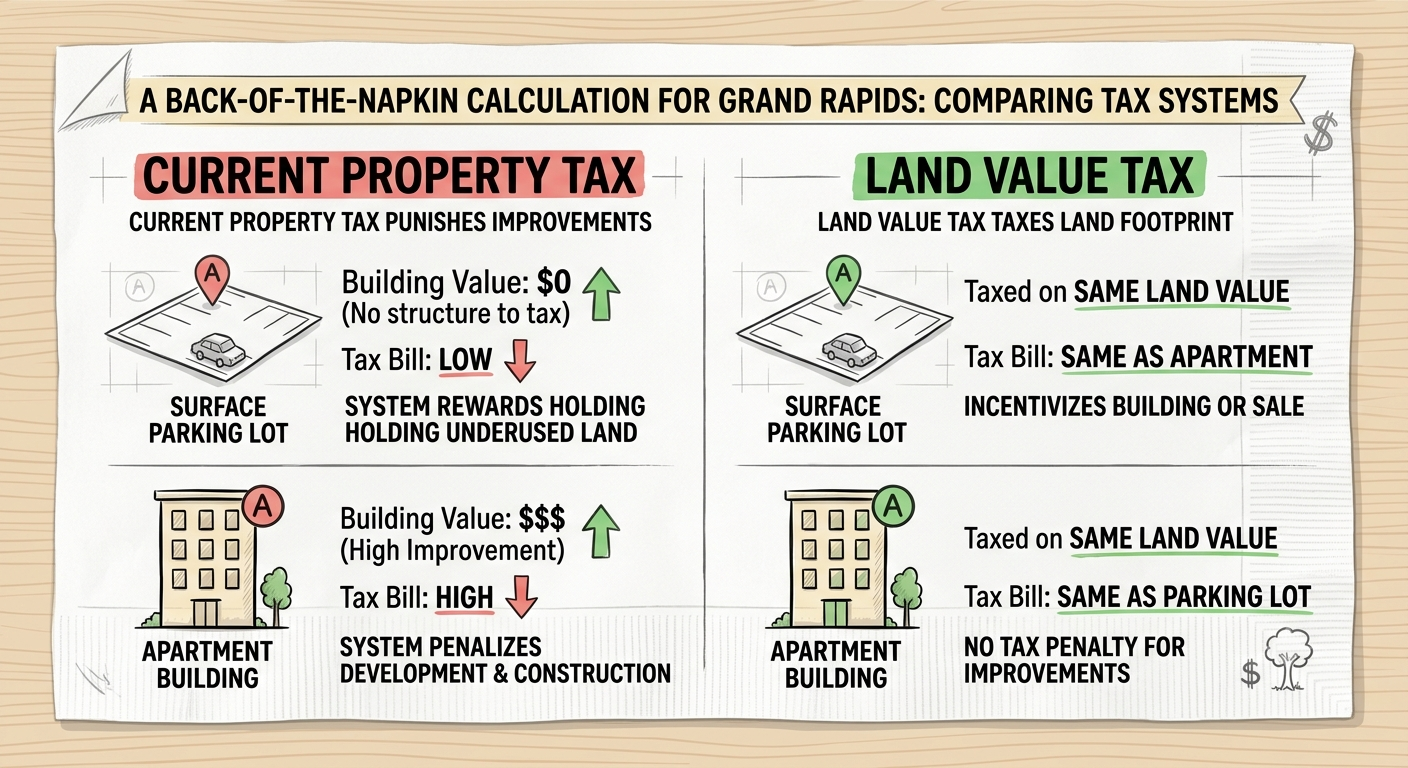
A quick real-world example:
On a recent townhouse project I built in Grand Rapids, one unit sits on just 0.064 acres and paid $6,4301 in total property taxes last year. That tax bill is driven largely by the value of the building. Under a land-value-focused system, the same parcel would likely owe far less because the tax would be based primarily on the land rather than the improvement. I’ll come back later and estimate exactly how much lower that bill might be using citywide Grand Rapids data.
This entire video is excellent, but I’ve synced it to pertinent section for this discussion.
“Our zoning codes ban the buildings that work, and then our tax codes punish the people that build them.”
A Brief Primer on How Property Taxes Work
Michigan property taxes are based on Taxable Value (TV), which is usually lower than a property’s State Equalized Value (SEV). SEV is intended to equal roughly 50% of market value, while TV is limited by Proposal A (1994).
Proposal A caps annual growth in taxable value to inflation (up to 5%) until a property sells. When it transfers ownership, its taxable value “uncaps” and resets to its SEV.
This creates two important effects:
- longtime owners often pay much less tax than new owners of similar properties;
- new development bears a disproportionately high tax burden because every newly sold property starts at full taxable value.
Meanwhile, Headlee (1978) prevents local governments from increasing tax revenue from existing property faster than inflation by automatically reducing (“rolling back”) millage rates when taxable value grows rapidly.
The result is a system where new buyers and new construction shoulder much more of the tax burden than properties that have been held for decades.
2026 State Equalized Values (SEV)
Real Property Only — Values in Millions of Dollars
| Class | Ad Valorem | IFT | NEZ | OPRA | TRCTA | CFT | Total SEV | % Total |
|---|---|---|---|---|---|---|---|---|
| Commercial | 3,251.1 | 11.7 | 85.3 | 37.1 | 0.0 | 3.1 | 3,388.3 | 27.6% |
| Industrial | 405.0 | 41.1 | 0.0 | 5.4 | 0.0 | 0.0 | 451.5 | 3.7% |
| Residential | 8,408.8 | 0.0 | 4.2 | 0.0 | 3.9 | 0.0 | 8,416.8 | 68.7% |
| TOTAL | 12,064.9 | 52.8 | 89.6 | 42.5 | 3.9 | 3.1 | 12,256.7 | 100.0% |
2026 Taxable Values (TV)
Real Property Only — Values in Millions of Dollars
| Class | Ad Valorem | IFT | NEZ | OPRA | TRCTA | CFT | Total TV | % Total |
|---|---|---|---|---|---|---|---|---|
| Commercial | 2,342.4 | 11.7 | 76.8 | 28.0 | 0.0 | 3.1 | 2,462.5 | 31.9% |
| Industrial | 277.2 | 41.1 | 0.0 | 4.9 | 0.0 | 0.0 | 323.3 | 4.2% |
| Residential | 4,931.6 | 0.0 | 3.7 | 0.0 | 3.5 | 0.0 | 4,938.7 | 63.9% |
| TOTAL | 7,551.2 | 52.8 | 80.5 | 33.5 | 3.5 | 3.1 | 7,724.5 | 100.0% |
Source: City of Grand Rapids Assessor’s Office (2026), 2026 Assessment Roll Report, p. 6 and 8 (published May 22, 2026). Values converted to millions of dollars; exempt properties omitted.
Notice that the taxable value is more than $4.5 BILLION less than the SEV. The city’s total taxable value is only about 63% of its total SEV. That’s an enormous tax preference advantage enjoyed by existing property owners. This can create an inefficient “lock-in” effect. Imagine empty nesters who live in a 4-bedroom house but only use 1 bedroom. They might desire to downsize, but they realize that if they did that, their property taxes would increase. So they stay put. This is a poor system design.
I unfortunately don’t have data on the percentages of homestead exemptions (the technical term is “Principal Residence Exemption” [PRE]), so let’s calculate it both ways.
From my previous analysis on GR Housing, I calculated that there are 19,985.6 acres of taxable properties in the City of GR. Total millage rates (mills) for 100% PRE properties is 33.8065. For 0% PRE, it’s 51.8065. “Mills” is the amount you pay for $1000 of taxable value. So if you buy a house that costs $200k, your SEV and Taxable Value would be set at $100,000. You then divide that by $1000, which gets you 100. And then you multiply that by your mills. If you live in the house, you’ll pay $3381. If you don’t, you’ll pay $5181.
If the Assessor’s Report included the total amount of taxes collected, that would make this analysis much easier. I considered pulling the actual property tax received from the Comptroller’s Annual Comprehensive Financial Report, but that only shows what the City received, which is only about 25%-33% of the total amount of property taxes collected. The rest gets forwarded to Kent County and the State of Michigan.
Instead, I’m choosing to calculate the estimated possible range. While each of these scenarios is unreasonable, they do provide an upper and lower bound for the property tax charged.
These breaks only happen for residential property, so commercial and industrial pay full price. They make up 36.1% of total TV. Their combined $2,785.8 M TV produces $144.3 M in tax revenue. (2,785.80 / $1000 * 51.8065)
The remaining almost $5 billion taxable value of residential properties would generate somewhere between $167M and $255.9M in property taxes, depending on the mix of homeowner-occupied vs. non-homestead parcels:
100% homeowner-occupied: $4,938.7 M / 1000 * 33.8065 = $167.0M
0% homeowner-occupied: $4,938.7 M / 1000 * 51.8065 = $255.9M
The US Census estimates GR’s home-ownership rate is 54%, so let’s weight it that way: 167 * (.54) + 255.9 * (1-.54) = $207.9M. Add back in the commercial and industrial (144.3 M) and you get $352.2M. This is my estimated total current annual property taxes for Grand Rapidians.
Note: The Census saying 54% of occupied housing units are owner-occupied is NOT the equivalent to assuming 54% of residential taxable value receives PRE. Owner-occupied homes tend to be larger and more expensive, so 54% of units probably represents well over 54% of residential taxable value. The assessor could tease this out, but I unfortunately don’t have this data.
Translating This Into a Land Area Tax
To see what a flat land-area tax would need to charge per acre to raise the same revenue, divide the total taxes needed by the number of taxable acres: $352.2M/19,985.6 acres = $17,623/acre.
Remember the townhouse example sitting on 0.064 acres? Under my estimated LVT, the taxes for that parcel would be just 0.064 x $17,623 = $1,127.85 vs. $6,430 under the current system, for a savings of 5,302.57/year. That’s 2.6x more taxes for a lot that’s 54% smaller. That means I could drop rent by $442/month and remain revenue-neutral. That additional tax burden has to go somewhere. It may appear as higher rents, lower returns, or projects that never get built at all. We’ve essentially designed our system to penalize people for using land efficiently, which encourages inefficient land use.
I believe these hidden financial incentives drive much more of our society than most people think. People respond to incentives; if we want more people to use our limited land more efficiently, we should design our system to incentivize this.
A caveat: A true Land Value Tax (LVT) would vary by location since land value isn’t uniform across the city. Land downtown GR is worth more than land out by the airport. But estimating that for every single parcel isn’t a quick or easy process. Instead, I estimate a flat per-acre rate as a simplifying proxy to get the right order of magnitude, so what I’m calculating is closer to a flat land-area tax: it’s a simplification that’s good enough to estimate the right order of magnitude, but it’s not literally what a properly assessed LVT would bill any individual parcel.
With that caveat in mind, let’s look at what the median lot might pay in taxes. Based on my experience, the median lot in the City of GR seems to be around just over 1/8 of an acre at 6250 square feet (50’ of frontage and 125 deep). That’s 0.14 acres. That translates into an annual tax bill of $2467/lot.
Sanity-Checking This Number Against Actual City Revenue
When making estimates, I like to validate against another source to make sure I’m in a reasonable range. From the FY2025 Annual Comprehensive Financial Report (FY26 wasn’t released at the time I did this analysis), page 154 shows a chart of historical property tax levies with FY25 being $54.6M. They’ve been averaging an increase of 7.1%/year, so growing the expected amount for this year gives $58.5M. That’s about 16.6% of my estimate (58.5/352.2). The tax assessor told me that City revenue is somewhere between 25-33% of property taxes collected, so my estimate suggests that total taxes are lower than I estimated, meaning the land tax I calculated would also be lower.
What a Land Value Tax Would Incentivize
- More infill and missing middle housing since the more units you build on a parcel, the cheaper each unit’s share of the land tax becomes.
- Lower land prices, by increasing the cost of holding unbuilt land.
- Less need for expensive and time-consuming Brownfield relief, since the property taxes wouldn’t be egregiously high in the first place
- Downward pressure on rents and prices over time as additional supply is added
- Elimination of the “lock-in” effect described above.
- Development by smaller developers who don’t have the time, resources, or knowledge to navigate the expensive, time-consuming brownfield process to request property tax relief.
- Higher quality buildings. Today’s property tax system unintentionally penalizes developers who invest in durable materials and better design. Brick instead of vinyl siding, real stone instead of synthetic, or architectural detailing all increase a building’s assessed value—and therefore its annual tax bill. A land value tax removes that penalty. Because the tax no longer depends on the building itself, developers can invest in longer-lasting, higher-quality construction without increasing their future tax burden.
What It Would Disincentivize
- Land Speculation. Currently, holding a vacant lot costs very little - a couple hundred dollars a year in taxes - so you can afford to sit on it and do nothing.
- Surface Parking Lots. These are a very inefficient use of land, and would likely become economically unviable under an LVT, pushing owners to either develop or sell.
- Neglect and Blight. Crappy housing wouldn’t mean cheaper taxes anymore.
- Cheap, low-value buildings. Think 5-over-1s or big box stores like Lowe’s, Walmart, or Meijer. If you want real numbers on how big-box retailers have exploited the current system, look up the “dark store” strategy:here’s a breakdown of how it works, here’s how Walmart used it to cut its annual bill to Sault Ste. Marie from $5.7M to $2.9M and forced the city to refund prior payments, and here’s a report documenting the same pattern elsewhere. One MLive estimate put the cumulative cost to Michigan communities as high as $2 billion
To Be Fair: Where This Gets Hard
I don’t want to oversell this. There are real, well-documented reasons LVT hasn’t taken over the country, and a fair treatment of the idea has to engage with them:
Assessing land value separately from building value is genuinely difficult. You need an assessor’s office that can credibly separate the two, and Pittsburgh’s experience is a cautionary tale. Pittsburgh ran a split-rate (partial LVT) system successfully from 1913 to 2001, taxing land at multiple times the rate of buildings. It survived the Great Depression in better shape than most peer cities and fueled a downtown construction boom in the 1980s. But the city had let its land assessments lag for decades. When a court-ordered reassessment in 2000–2001 finally caught land values up to reality, land valuations jumped 81% overnight, homeowners revolted, and the city scrapped the whole system. It wasn’t because split-rate taxation didn’t work, but because the underlying assessments had been broken for fifty years and nobody wanted to be the generation that fixed them all at once. Grand Rapids’ own SEV process, which I criticize above for using generic tables rather than real market data, would need to get more rigorous under an LVT, not less. The whole idea depends on assessors actually being able to defend a land number separately from a building number.
This could hurt exactly the kind of resident I’d otherwise want to protect. A land value tax raises the relative tax burden on well-located land — which describes a lot of older, modest housing close to downtown and transit corridors. A long-time homeowner on a fixed income, sitting on a now-valuable lot near a transit line, isn’t “speculating” in any meaningful sense, but a pure LVT would still raise their bill. That’s a real tension with the walkability and transit goals I care about, and it deserves an honest answer rather than a hand-wave. Most LVT proposals pair the tax with a deferral program or circuit-breaker for owner-occupants so longtime residents aren’t priced out of their own neighborhoods by appreciation they didn’t cause and can’t easily cash in on.
There’s also an open legal question. Headlee and Proposal A, which structure how Michigan property taxes work today, were both written with the existing land-plus-improvement model in mind. Whether a city could implement a true LVT under the current state constitution, or whether it would require new enabling legislation (or a constitutional amendment), isn’t something I’ve fully worked out. This piece is making an economic argument as opposed to a legal one.
Making this more politically palatable
Implementing a full LVT citywide overnight would be a lot, and Pittsburgh’s history above is a good argument for not doing it that way. The better-tested path is a split-rate tax: land taxed at a meaningfully higher rate than buildings, phased in gradually rather than all at once. Harrisburg, PA adopted split-rate taxation in 1975 after Hurricane Agnes devastated its downtown, and over the following decade and a half, vacant and boarded-up properties fell from over 5,000 to a few hundred while the number of businesses more than quadrupled. Roughly 15–20 Pennsylvania cities still use a split-rate system today. Pittsburgh’s failure was an assessment-administration failure, versus an invalidation of the underlying idea. Harrisburg’s multi-decade track record is the better model to point to.
A realistic path for Grand Rapids might combine a few things:
- state enabling legislation that lets cities opt into split-rate taxation incrementally (say, starting at a modest 2:1 land-to-building ratio and adjusting from there, the way Pittsburgh itself phased in its original rate over twelve years)
- a circuit-breaker or deferral program for owner-occupants so longtime residents in appreciating areas aren’t forced out by a tax bill that outpaces their income
- a serious upgrade to the Assessor’s Office’s ability to value land and improvements separately and defensibly, learning directly from why Pittsburgh’s system eventually broke.
Conclusions
Every tax system creates incentives. Michigan’s current system rewards holding underused land and pushes developers toward the cheapest available materials to minimize their tax burden. Whether or not a land value tax is the answer, it’s worth asking why our tax code still rewards a parking lot over a building.
(total tax across all taxing entities — city, county, school, and state) ↩︎